
A title that works for a Minecraft challenge can flop on a personal finance explainer. Gamers, students, investors, and home cooks come to YouTube with different goals, so the titles that earn their clicks look different too.
Every title has two jobs. It has to match what the viewer is looking for, so YouTube can show it in the right place, and it has to persuade the right viewer that this video is worth their time.
In this guide, we combine YouTube’s official title guidance with an original analysis of 492 top-ranking search results across 10 niches. You’ll see which title formats dominate each niche, how long top titles are, and which patterns are worth borrowing. One caveat up front: a video ranking in search doesn’t prove its title caused the ranking or the views, so treat every pattern here as a starting point to test, not a rule. At the end, we’ll show you how to turn these patterns into ready-to-test title options with Optofriend.
About the data. We searched YouTube for 50 keywords (five per niche, each labeled with a search intent such as tutorial, comparison, or review) and recorded the top 10 results for each. That gave us 492 results covering 486 unique videos with a combined 982 million views. The full methodology is in How We Analyzed YouTube Titles.
Key Findings at a Glance
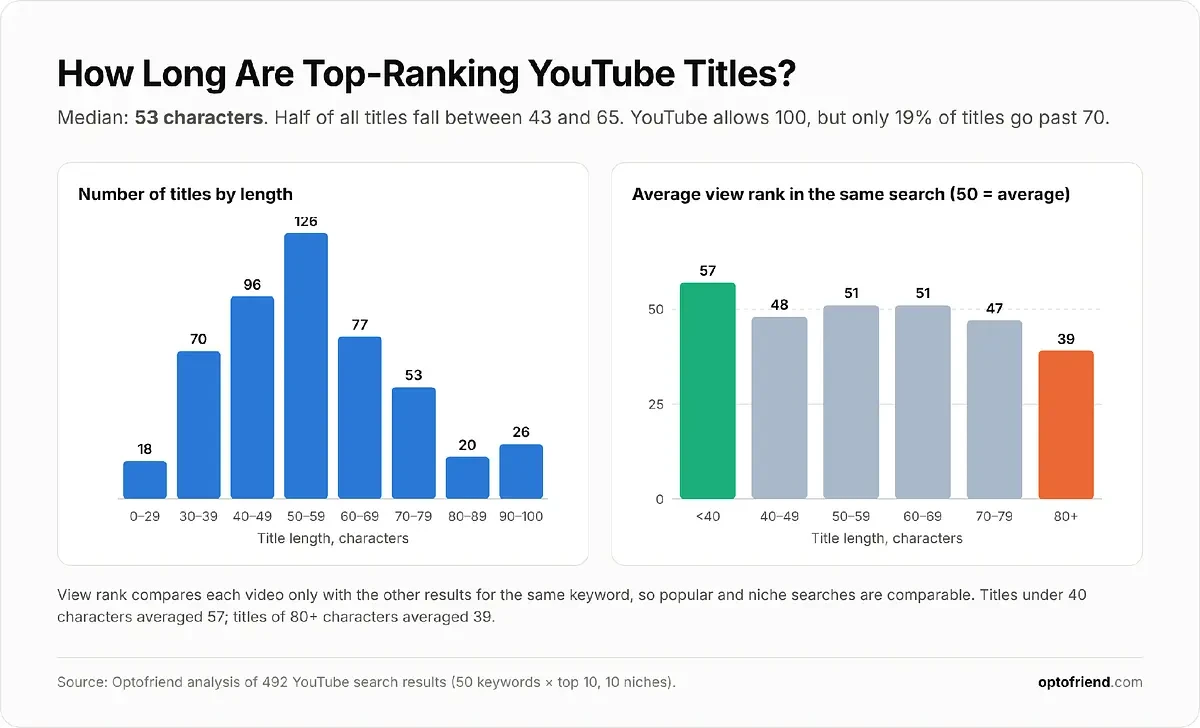
Top titles are short. The median title is 53 characters long, and half of all titles fall between 43 and 65 characters. Only 19% use more than 70 of the 100 characters YouTube allows.
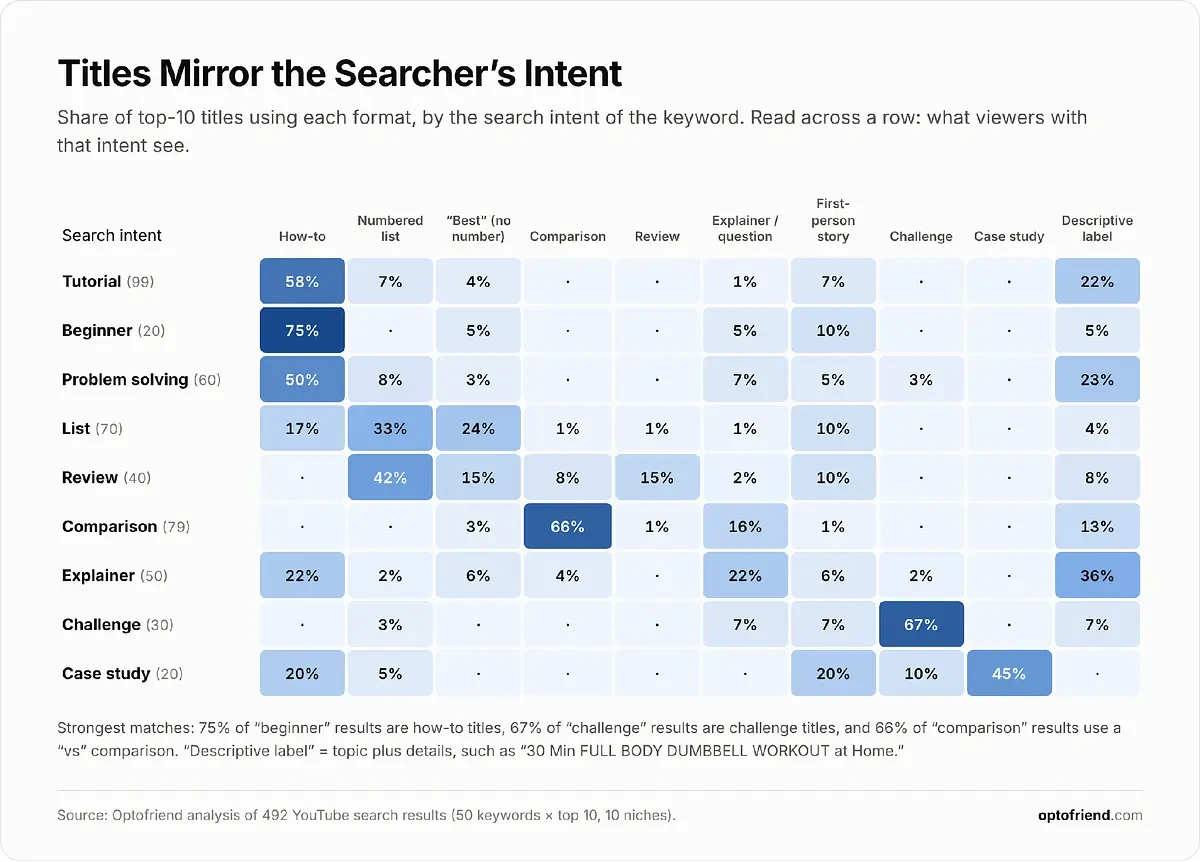
Titles mirror search intent. 66% of results for comparison keywords use a “vs” comparison title, 67% of challenge results use a challenge title, and 75% of beginner results are how-to titles.
Few titles repeat the search phrase exactly. Only 10% contain the exact keyword, but 60% place at least one of its words within the first three words of the title.
Matching the keyword word for word doesn’t mean more views. Within the same search, titles that contained every word of the keyword averaged a view rank of 44 out of 100, compared with 55 for titles that didn’t.
Shorter titles went with more views. Titles under 40 characters averaged a view rank of 57, while titles of 80 characters or more averaged 39.
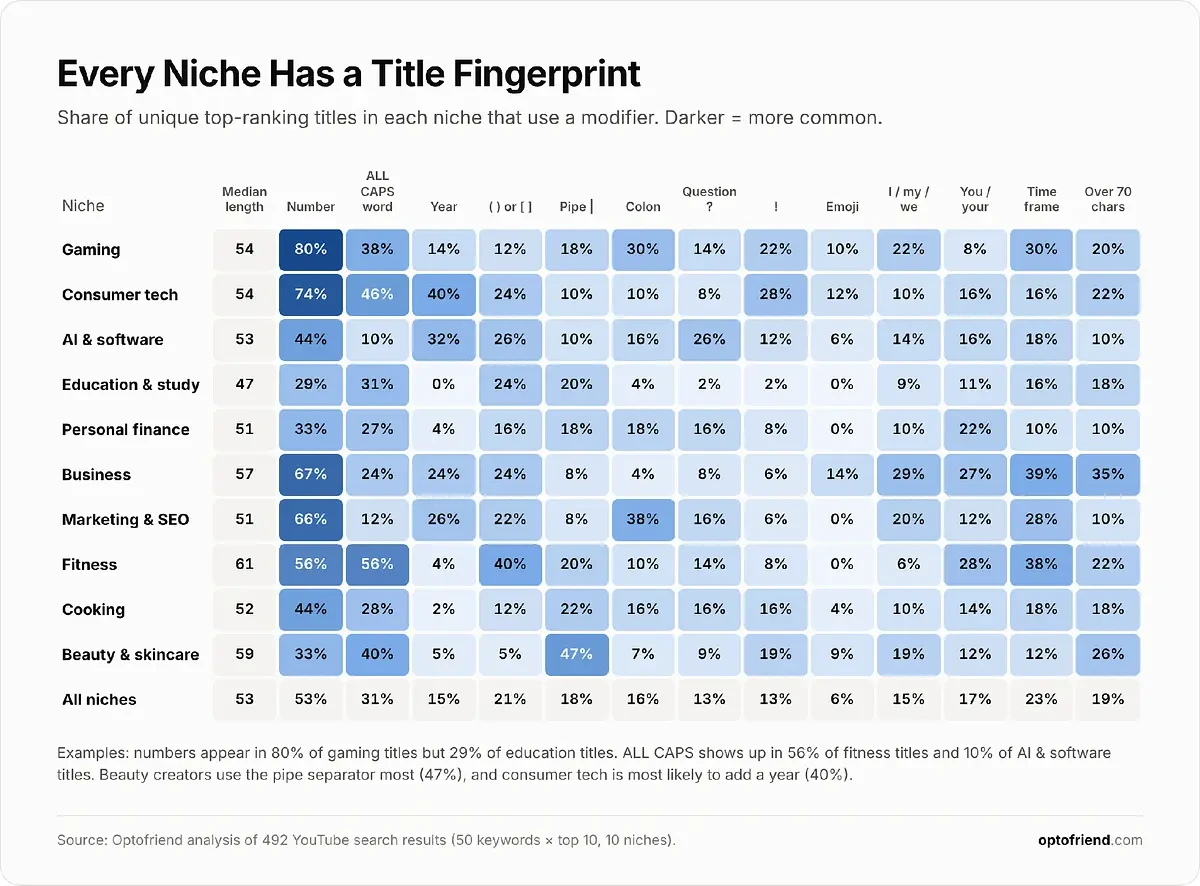
Every niche has its own style. Numbers appear in 80% of gaming titles but only 29% of education titles. ALL CAPS words appear in 56% of fitness titles and 10% of AI and software titles. 40% of consumer tech titles include a year; no education title does.
Some niches agree on a format, others don’t. In gaming, the most common format accounts for 82% of a keyword’s top 10 on average. In cooking and beauty, it’s about half.
What Is a YouTube Title and Why Is It Important
A YouTube title is the line of text that appears next to or under your thumbnail in search results, on the Home feed, in suggested videos, and above the video on the watch page. YouTube limits titles to 100 characters, and that’s all the space you get to explain what the video is and why someone should watch it.
The title matters for three reasons:
It tells YouTube what the video is about. In its explanation of how search works, YouTube lists the title among the factors it uses to estimate relevance, alongside tags, the description, and the video content.
It helps viewers decide. YouTube’s A/B testing documentation describes titles and thumbnails as a way to help viewers understand what a video is about, so they don’t waste time clicking on the wrong one.
It affects what happens after the click. According to YouTube’s title tips, if a title doesn’t accurately represent the video, viewers may stop watching, which can hurt its discoverability.
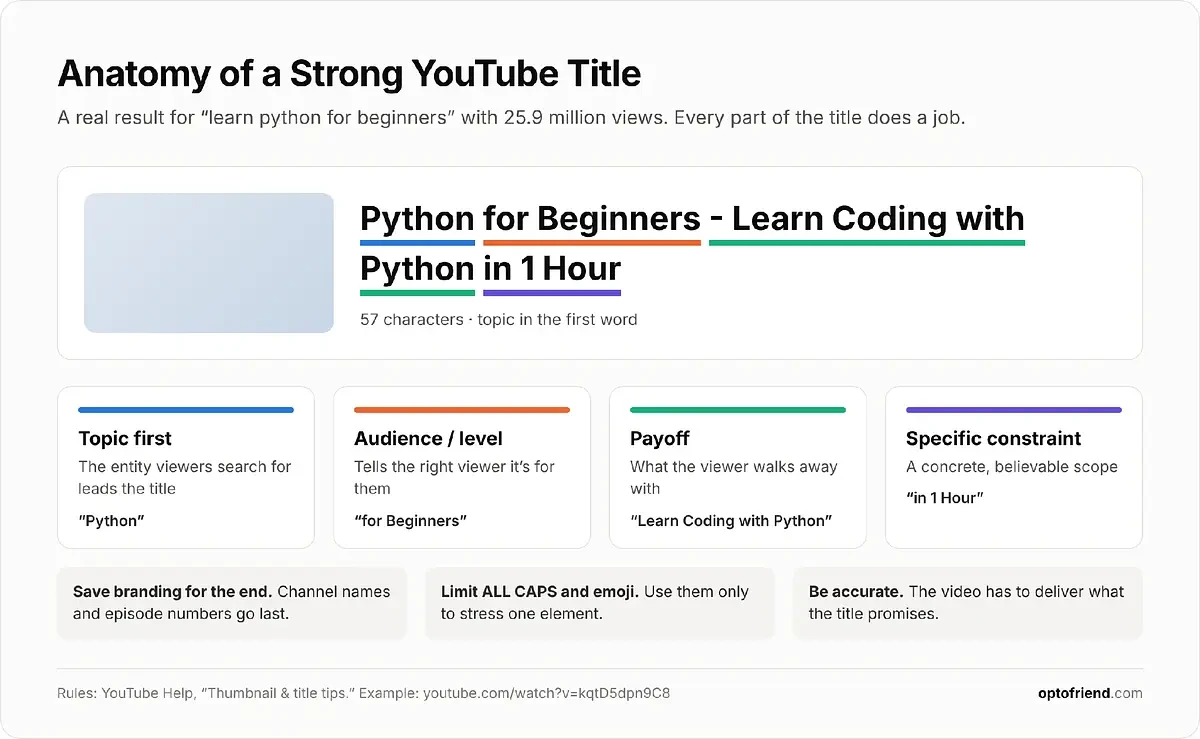
Here’s what that looks like in a real top-ranking title:
Why YouTube Title Best Practices Differ by Niche
People open YouTube with different goals: to learn a skill, solve a problem, decide on a purchase, follow a story, be entertained, or relax. The title has to speak to that goal, and the goal changes from niche to niche.
Search vs. browse. YouTube distinguishes between searchable titles, which clearly outline what to expect, and intriguing titles, which spark curiosity in viewers who may not be looking for topic-specific content. A how-to video lives on search, so its title needs the words people type. A challenge or story video often travels through Home and suggested videos, so its title can lean on curiosity.
Stakes. Finance, skincare, and health-adjacent fitness topics call for specificity and trust. Gaming and vlogs reward novelty and personality. Tech reviews depend on exact model names, because viewers search for the specific product they’re considering.
Evergreen vs. time-sensitive. A calculus explainer stays useful for years, while a “best phones” list is outdated in months. That’s why 40% of consumer tech titles in our sample include a year, while none of the education titles do.
Search intent is the clearest predictor of title format in our data. The table shows what each intent calls for and how often the top 10 results actually use the matching format:
Search intent |
What viewers need |
Title information to prioritize |
Example formula |
Share of top-10 titles using it |
|---|---|---|---|---|
Tutorial or beginner |
Step-by-step help at their level |
Task, tool, skill level, duration |
How to [task] for [level] ([duration]) |
58% how-to (75% for beginner keywords) |
Problem solving |
A fix that works |
The problem, the method, the context |
How to Fix [problem] ([method]) |
50% how-to |
Comparison |
A decision |
Both options and the deciding factor |
[A] vs [B]: [deciding factor] |
66% comparison |
List |
Options to choose from |
Number, category, audience, year if it matters |
[N] Best [things] for [audience] |
57% numbered or “best” list |
Review |
A verdict |
Product, model, verdict or question |
[Product] Review: [verdict or question] |
42% numbered list, 15% review |
Explainer |
Understanding |
The concept, a question, an angle |
Why [thing] [happens] |
22% question, 36% descriptive label |
Challenge |
To see a result |
Goal, time frame, stakes |
[Goal] for [time frame] |
67% challenge |
Case study |
Proof |
Result, metric, time frame |
[Result] in [time frame]: [how] |
45% case study, 20% first-person |
Universal YouTube Title Best Practices (Official Guidance + Our Data)
These rules apply in every niche. Each one combines what YouTube’s own title tips recommend with what we saw in the 492 search results.
Be Accurate and Deliver on the Title’s Promise
YouTube’s first title rule is to be accurate: the title should represent the video, because viewers who feel misled may stop watching, which can impact discoverability. YouTube’s A/B testing tool reflects the same priority. It picks the winning title by watch time rather than clicks, so a title that attracts clicks but loses viewers after a few seconds loses the test.
The most-viewed titles in our sample make specific promises that the video can keep, such as “Learn Python - Full Course for Beginners [Tutorial]” (49.6M views) or “How Google Search Works (in 5 minutes)” (20.7M views).
Front-Load the Topic and Keep It Concise
YouTube advises keeping titles short because viewers may only see part of them, putting the most important words near the beginning, and saving episode numbers and branding for the end. The 100-character limit is a ceiling, not a target.
Top-ranking titles follow this closely. The median title is 53 characters, and 60% of titles place a keyword word within the first three words. Branding usually goes at the end, as in “3 Easy One-Pan Chicken Dinners | Allrecipes” or “Derivative as a concept | Derivatives introduction | AP Calculus AB | Khan Academy”.
Shorter titles were also associated with more views in our data. Titles under 40 characters averaged a view rank of 57 out of 100 within their search, while titles of 80 characters or more averaged 39. That doesn’t mean you should cut useful information, but it does mean every extra word should earn its place.
Use the Words Your Audience Searches For, Without Stuffing
A title should use the language viewers actually use. YouTube suggests looking at the research insights in YouTube Analytics to see what your audience searches for. That doesn’t mean repeating the keyword verbatim: only 10% of top results contain the exact search phrase, and 45% contain all of its words in any order.
Top creators work the topic in naturally, as in “ChatGPT Tutorial: How to Use Chat GPT For Beginners” (5.0M views). The opposite approach, piling up keyword variations, produces titles like “50 DAYS TO PAY OFF $13,000 CREDIT CARD DEBT | DEBT PAYOFF | DEBT FREE | CREDIT CARDS | BOLD FAITH”, which reads like a tag list and gets cut off in most places it appears.
Choose Searchable, Intriguing, or Hybrid Framing
YouTube suggests choosing between searchable and intriguing titles by thinking about who may watch your video and where they may find it. Our sample contains all three approaches:
Searchable: “Roth IRA vs Traditional IRA: Which Is Better?” (271K views). It states the topic and the decision.
Intriguing: “Why is THIS the Best Selling Phone?” (9.7M views) is the most-viewed result for “best budget smartphones,” even though it never mentions budget phones.
Hybrid: “Notion VS Obsidian - Why I Use BOTH” (303K views) leads with the searchable comparison and ends with a curiosity hook.
For most creators, the hybrid is the safest starting point: put the searchable topic first, then add the reason to click.
Make the Title and Thumbnail Work Together
Our dataset doesn’t include thumbnails, so this rule comes from YouTube’s guidance, which shows examples of titles and thumbnails working together to create interest and tell a story. In practice, give each one a different job. The thumbnail shows the subject or the result, and the title explains it. Repeating the same words in both wastes space that could carry extra information.
Use ALL CAPS, Emoji, Numbers, and Dates Selectively
YouTube recommends limiting ALL CAPS and emoji and using them carefully to emphasize emotion or special elements in the video. In our sample, 31% of titles contain at least one ALL CAPS word, 53% contain a number, 15% contain a year, and only 6% use an emoji.
None of these traits showed a reliable link to views. Titles with years averaged fewer views, but that’s most likely because they’re newer videos that have had less time to collect them. Use these elements when they carry information, such as a model number, a time frame, or a year that changes the answer, rather than as decoration.
The Major YouTube Title Formats (With Real Examples)
We sorted every title in the sample into one of 11 formats. The table lists each one with a reusable formula, how common it is, where it fits, and a real example from the top 10 results. The share is calculated across 486 unique videos.
Format |
Formula |
Share |
Best fit |
Real example |
Avoid |
|---|---|---|---|---|---|
How-to / tutorial |
How to [task] [context] |
28% |
Tutorial, beginner, and problem-solving searches |
“Learn Python - Full Course for Beginners [Tutorial]” (49.6M views) |
Vague tasks with no context |
Descriptive label |
[Topic] + [details: time, level, equipment] |
16% |
Fitness, beauty, cooking |
“30 MIN FULL BODY WORKOUT || At-Home Pilates (No Equipment)” (26.7M views) |
So many details that the topic gets cut off |
Numbered list |
[N] [things] for [audience or result] |
13% |
Lists, reviews, ideas |
“The 9 BEST Scientific Study Tips” (13.9M views) |
Padding a list to reach a big number |
Comparison |
[A] vs [B]: [deciding factor] |
12% |
Comparison searches in tech, finance, gaming |
“iPhone 13 Pro Max vs Samsung Galaxy S21 Ultra CAMERA TEST 🔥” (8.5M views) |
Not saying what is being compared |
“Best” list (no number) |
Best [things] for [audience] ([year]) |
7% |
Product and tool roundups |
“These Are the Best AI Tools in 2026” (523K views) |
Calling something “best” without showing why |
First-person story |
I [did X] [constraint or stakes] |
7% |
Business, marketing, budget cooking |
“I Made 8 Dinners For Two People On A $25 Budget (In NYC!)” (5.4M views) |
Earnings or results claims you can’t back up |
Explainer / question |
Why [thing] [happens] / What Is [concept]? |
7% |
Explainers, education, marketing |
“How Google Search Works (in 5 minutes)” (20.7M views) |
Asking a question the video doesn’t answer |
Challenge / transformation |
[Goal] for [time frame] |
5% |
Gaming, fitness |
“100 Days in a Minecraft World” (61.2M views) |
Guaranteeing physical results |
Case study / results |
[Topic] Case Study: [result] in [time] |
2% |
Marketing, SEO, business |
“SEO Case Study: Growing Website Traffic By 3012%” (76K views) |
Numbers with no context or proof |
Recipe / dish-first |
[Dish] + [time, budget, or method] |
2% |
Cooking |
“Meal Prep For The Week In Under An Hour | Sweet and Sour Chicken” (12.0M views) |
Naming the dish without a reason to pick this version |
Review / verdict |
[Product] Review: [verdict or question] |
2% |
Product and software reviews |
“Sony WH-1000XM6 Review: Back on the Throne!” (5.2M views) |
A verdict the video doesn’t support |
Two notes on these numbers. First, review-intent searches mostly return numbered lists (“Top 10 Tested & Reviewed”), which is why the dedicated review format looks rare. Second, our sample didn’t include ambience or ASMR content, so we can’t say how experience-based titles such as “[sound] for [activity or length]” perform. If you work in that space, test them against the formats above.
What Our Data Says About Titles and Views
To compare titles fairly, we ranked each video’s views only against the other results for the same keyword, on a scale from 0 (fewest views in that search) to 100 (most). That way, a 50,000-view video in a small niche isn’t compared directly with a 50-million-view Minecraft video.
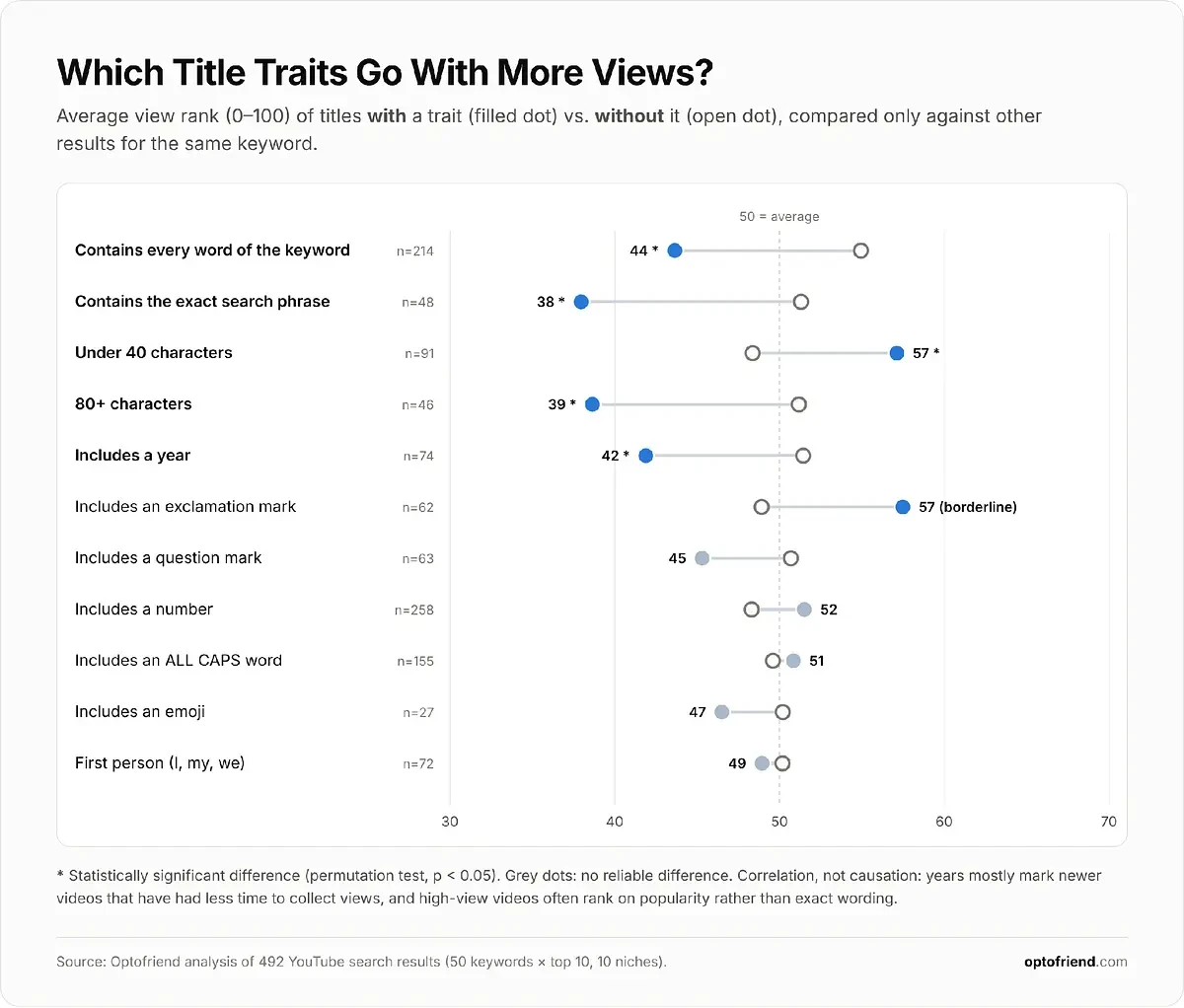
Keyword-matching titles had fewer views within the same search. Titles that contained every word of the keyword averaged a view rank of 44, versus 55 for those that didn’t. Titles with the exact phrase averaged 38. A likely explanation: YouTube uses engagement signals to determine relevance, so the most-watched videos can rank even with loosely matching titles, while smaller videos earn their spot by matching the query closely. Matching the keyword helps you become relevant. It doesn’t make you the most-watched result.
Shorter titles went with more views. Titles under 40 characters averaged 57, and titles of 80+ characters averaged 39.
Years went with fewer views, most likely because dated titles belong to newer videos.
Exclamation marks were borderline. Titles with one averaged 57 versus 49, but the difference sits right at the edge of statistical significance, so it’s not a reason to add one.
Everything else showed no reliable difference, including numbers, ALL CAPS, emoji, question marks, and first-person wording.
The takeaway: in this data, stylistic tricks don’t separate the most-viewed titles from the rest. Clarity, fit with the search intent, and concision do.
YouTube Title Best Practices by Niche
Here’s how titles differ across the 10 niches we studied. The quick-reference table summarizes each niche. “Format agreement” shows how often the top 10 results for a keyword share the same format, on average: high agreement means there’s a clear convention to follow, and low agreement means there’s room to stand out.
Niche |
Most common formats |
Median length |
Common modifiers |
Most-viewed example |
Editable formula |
Format agreement |
|---|---|---|---|---|---|---|
Gaming |
Numbered list 30%, how-to 26%, challenge 20%, comparison 20% |
54 |
Numbers (80%), game name + colon, ALL CAPS |
“100 Days in a Minecraft World” (61.2M views) |
[Game]: [N] [Easy] [Builds]! |
High (82%) |
Consumer tech |
How-to 28%, comparison 22%, numbered list 16%, “best” list 14% |
54 |
Model numbers, year (40%), ALL CAPS (46%) |
“Why is THIS the Best Selling Phone?” (9.7M views) |
[Model A] vs [Model B]: [test] |
Medium (68%) |
AI & software |
How-to 30%, comparison 18%, descriptive 16%, review 12% |
53 |
Tool name first (76%), questions (26%), year (32%) |
“ChatGPT Tutorial - A Crash Course on Chat GPT for Beginners” (6.0M views) |
[Tool] Tutorial: How to [task] |
Medium (64%) |
Education & study |
How-to 44%, descriptive 24%, explainer 11% |
47 |
Subject first, duration, no years or emoji |
“Learn Python - Full Course for Beginners [Tutorial]” (49.6M views) |
[Subject] Explained in [N] Minutes |
Medium (62%) |
Personal finance |
How-to 47%, comparison 24% |
51 |
“Beginner” (22%), “you/your” (22%), money terms |
“How To Manage Your Money Like The 1%” (8.3M views) |
[A] vs [B]: Which Is Better for [situation]? |
Medium (67%) |
Business |
How-to 33%, numbered list 24%, first-person 14% |
57 |
First person (29%), time frames (39%), 35% over 70 chars |
“6 Tips on Being a Successful Entrepreneur | John Mullins | TED” (5.4M views) |
[N] Business Ideas for [audience] |
Medium (56%) |
Marketing & SEO |
Case study 18%, first-person 16%, how-to 16%, comparison 16% |
51 |
Colons (38%), percentages, “#1” |
“How Google Search Works (in 5 minutes)” (20.7M views) |
[Channel] Case Study: [metric] in [time] |
Medium (58%) |
Fitness |
Descriptive 30%, how-to 22%, challenge 18% |
61 |
ALL CAPS (56%), brackets (40%), duration |
“200 PUSH UPS A DAY FOR 30 DAYS CHALLENGE - Epic Body Transformation” (46.8M views) |
[Duration] [Body Part] Workout ([equipment]) |
Medium (64%) |
Cooking |
Descriptive 18%, how-to 18%, recipe 18% |
52 |
“Easy/quick” (32%), budget (28%) |
“7 Easy Chicken Dinners” (17.0M views) |
[N] Easy [Dish Type] for [occasion] |
Low (52%) |
Beauty & skincare |
Descriptive 47%, “best” list 14%, how-to 14% |
59 |
Pipes (47%), ALL CAPS (40%), skin type |
“5-Minute No Foundation Makeup With Just 5 Products | Quick & Easy Everyday Look” (4.2M views) |
[Routine] for [Skin Type] | [Detail] |
Low (51%) |
Gaming
Gaming viewers search for a specific game and a specific outcome: a build, a strategy, a challenge to watch, or a platform to buy. They click when the title names the game and promises something concrete or entertaining.
Gaming has the most consistent titles in our sample: on average, 82% of a keyword’s top 10 share one format. All 10 results for “minecraft 100 days survival” are challenge titles, and all 10 for “ps5 vs xbox series x games” are comparisons. Numbers appear in 80% of gaming titles, the highest of any niche, and 70% put a keyword word in the first three words, usually the game name. A colon after the game name (“Minecraft: …”) appears in 30% of titles.
Examples from the top 10:
“100 Days in a Minecraft World” (61.2M views)
“Minecraft: 3 SIMPLE Starter Houses!” (31.9M views)
“The Beginner's Guide to Elden Ring” (7.0M views)
Formulas to adapt:
[Game]: [N] [Easy/Simple] [Builds or Tips]!
I Survived 100 Days [in/as] [twist] in [Game] [mode]
[Platform A] vs [Platform B]: Which Is Best for [game or use]?
Do: Lead with the game name and follow the format the top results already agree on. In gaming, the convention is strong, so deviate only when you have a clear twist.
Avoid: Repeating the keyword in a second half of the title, as in “19 Elden Ring Starting Tips for Beginners - ELDEN RING BEGINNER TIPS ps5 GAMEPLAY.” The second half adds nothing a viewer needs.
Consumer Tech and Gadgets
Tech viewers are usually close to a purchase or stuck with a problem. They want exact models, honest comparisons, and fixes that work on their device.
Comparison and how-to titles dominate (22% and 28%). Model numbers drive the high share of titles with numbers (74%), and 40% of titles include a year, the highest of any niche, because product advice goes out of date quickly. Tech also uses ALL CAPS (46%) and exclamation marks (28%) more than most niches. The most-viewed result for “best budget smartphones” is a curiosity title that doesn’t mention budget phones at all.
Examples from the top 10:
“Why is THIS the Best Selling Phone?” (9.7M views)
“iPhone 13 Pro Max vs Samsung Galaxy S21 Ultra CAMERA TEST 🔥” (8.5M views)
“Top 9 Hacks to Keep Your Gaming Laptop COOL! ❄️💻” (1.1M views)
Formulas to adapt:
[Model A] vs [Model B]: [test] [result or question]
Best [category] [year]: [N] Tested for [use case]
How to Fix [problem] on [device] ([method])
Do: Name the exact model and generation. Viewers comparing phones search for specific models, and 9 of the 10 results for “iphone vs samsung camera test” name the exact models on both sides.
Avoid: Stacking specs until the title hits the limit. “9 minutes of BUILDING a GAMING PC | EASY POV PC BUILD FOR BEGINNERS | Ryzen 5 7500F + RTX 5070 ZOTAC” uses all 100 characters, and most of it gets cut off.
AI Tools and Software
Software viewers want to get a task done with a specific tool, or decide which tool is worth paying for. The tool name is the anchor of nearly every search.
AI and software titles match the keyword more closely than any other niche: 80% contain every keyword word and 76% place a keyword word within the first three words. Questions are most common here (26%), usually “Is it worth it?” in reviews. ALL CAPS is rare (10%), and 32% include a year because tools and pricing change. Interestingly, the top three results for “canva pro review” are all “Canva Free vs Canva Pro” comparisons: viewers asking for a review really want to know whether to upgrade.
Examples from the top 10:
“ChatGPT Tutorial - A Crash Course on Chat GPT for Beginners” (6.0M views)
“How to easily automate boring Excel tasks with Power Query!” (1.8M views)
“Canva Free vs. Canva Pro: Is Canva Pro Worth it? [Honest Review]” (34K views)
Formulas to adapt:
[Tool] Tutorial: How to [task] for Beginners
[Tool A] vs [Tool B]: [who it’s for]
Is [Tool or Plan] Worth It in [year]? [Honest Review]
Do: Put the tool name first and name the task. Add a version or year when the interface or pricing changes often.
Avoid: Hype without a task. “AI” and “game-changer” tell the viewer nothing about what they’ll be able to do after watching.
Education and Studying
Learners want to understand a subject or study more effectively, and they want to know upfront whether the video matches their level and how long it will take.
Education has the shortest titles in our sample (median 47 characters) and the least decoration: no titles include a year or emoji, and only 2% use a question mark or exclamation mark. How-to titles lead (44%). The top three results for “calculus derivatives explained” are all short and plain, and the most-viewed one is only 23 characters long.
Examples from the top 10:
“The essence of calculus” (12.0M views)
“Python for Beginners - Learn Coding with Python in 1 Hour” (25.9M views)
“Why you procrastinate even when it feels bad” (11.1M views)
Formulas to adapt:
[Subject or Topic] Explained in [N] Minutes
How to [study goal] ([method or level])
Why You [problem] (and How to [fix])
Do: Lead with the subject and state the level and duration. “For Beginners” and “in 1 Hour” tell viewers exactly what they’re signing up for.
Avoid: Adding a year to evergreen material. A calculus explainer doesn’t expire, and a dated title makes it look like it does.
Personal Finance
Finance viewers want to make a decision or fix a problem with their money, and they’re rightly wary of hype. Titles that win their trust name the concept, the scenario, and the audience.
How-to titles make up 47% of personal finance results, the highest share of any niche, and comparison titles another 24%. All 10 results for “roth ira vs traditional ira” are comparisons. Finance titles speak to the viewer directly (“you/your” in 22%) and often state the level (“for beginners” in 22%). No titles use emoji.
Examples from the top 10:
“Roth IRA vs Traditional IRA: Which Is Better?” (271K views)
“Pay Off Debt Using the Debt Snowball” (1.8M views)
“Budgeting for Beginners - How to Make a Budget From Scratch Today” (1.1M views)
Formulas to adapt:
[Option A] vs [Option B]: Which Is Better for [situation]?
How to [goal] [as a beginner / on a $X income]
[Method] Explained: How to [outcome]
Do: Name a concrete method or scenario, like “Debt Snowball” or “From Scratch.” Specific titles signal that the video contains a real plan.
Avoid: Promises the video can’t guarantee. Big outcome claims (“become a millionaire”) do appear among top results, but with money at stake, a claim the video doesn’t back up costs you trust and watch time.
Business and Entrepreneurship
Business viewers look for ideas, proof that something works, and a path they can follow. Personal stories and specific milestones carry a lot of weight.
Business has the most long titles in our sample: 35% exceed 70 characters, and the median for “how to start a small business” is 86.5. First-person wording (29%) and time frames (39%) are more common here than in any other niche. List titles own “small business ideas,” where 9 of the top 10 are numbered lists.
Examples from the top 10:
“Top 20 Best Small Business Ideas for Beginners in 2026” (5.4M views)
“How I Built a SaaS Startup (From Idea to Revenue)” (1.0M views)
“Watch this to get your first 5 customers” (1.6M views)
Formulas to adapt:
[N] Small Business Ideas for [audience] [under $X]
How I [built or grew] [business] ([milestone or time frame])
How to Get Your First [N] Customers ([method])
Do: Use a specific milestone or number, such as “first 5 customers” or “From Idea to Revenue,” rather than vague success language.
Avoid: Unverifiable earnings claims. Revenue figures in titles are common in this niche, but treat them as claims, not best practices: if the video can’t back the number, leave it out.
Marketing and SEO
Marketers want tactics that produce measurable results. They respond to proof: case studies, percentages, and before-and-after numbers.
Marketing titles are the most varied in our sample: case study, first-person, how-to, and comparison formats each make up about 16 to 18%. Colons are more common here (38%) than anywhere else, usually separating the topic from the result (“SEO Case Study: …”). Numbers appear in 66% of titles, mostly as percentages, ranks, and time frames.
Examples from the top 10:
“How Google Search Works (in 5 minutes)” (20.7M views)
“YouTube SEO: How I Rank #1 on YouTube in 2026” (316K views)
“SEO Case Study: Growing Website Traffic By 3012%” (76K views)
Formulas to adapt:
[Channel] Case Study: [metric] in [time frame]
[Platform] SEO: How I [result] in [year]
[Platform A] vs [Platform B]: Which Is Better for [business type]?
Do: Pair the result with the metric and time frame, as in “10X Traffic in 1 Year.” A number without context reads like hype.
Avoid: Outdated platform names. In the “google ads vs facebook ads” results, newer titles say “Meta Ads.” Use the names your viewers use today.
Fitness and Training
Fitness viewers want a workout that fits their time, equipment, and level, or a transformation they can believe in. Specifics decide the click.
Fitness titles are spec-led: duration, body part, equipment, and level. ALL CAPS (56%) and brackets (40%) are more common here than in any other niche, usually to highlight the duration (“30 MIN”) and conditions (“No Equipment”). The median title is 61 characters, the longest of any niche. Challenge titles own “30 day push up challenge,” where 9 of the top 10 are challenge titles.
Examples from the top 10:
“25 MIN FULL BODY HIIT for Beginners - No Equipment - No Repeat Home Workout” (35.0M views)
“200 PUSH UPS A DAY FOR 30 DAYS CHALLENGE - Epic Body Transformation” (46.8M views)
“How to PROPERLY Squat for Growth (4 Easy Steps)” (4.8M views)
Formulas to adapt:
[Duration] [Body Part] Workout at Home ([equipment], [level])
I Did [N] [Exercise] Every Day for [N] Days
How to Fix [form issue] ([N] Steps)
Do: Lead with the duration and target, then add equipment and level. These are the filters viewers use to choose a workout.
Avoid: Guaranteed results. A title like “30 DAY PUSH-UP CHALLENGE(RESULTS GUARANTEED)” promises something no video can guarantee for every viewer.
Cooking and Recipes
Home cooks want to know what they’ll make, how long it takes, and whether it fits their budget and skill. The dish and one practical constraint usually decide the click.
Cooking is one of the two least consistent niches in our sample (52% format agreement), so there’s room to experiment. The most common modifiers are practical: “easy,” “simple,” or “quick” (32%) and budget terms (28%). Some of the most-viewed titles are also the shortest: “7 Easy Chicken Dinners” has 17 million views with just 22 characters.
Examples from the top 10:
“7 Easy Chicken Dinners” (17.0M views)
“Meal Prep For The Week In Under An Hour | Sweet and Sour Chicken” (12.0M views)
“Oven vs. Air Fryer Taste Test” (4.2M views)
Formulas to adapt:
[N] Easy [dish type] for [occasion]
[Dish] - [time] [method or style]
I Made [N] Meals for [people] on a $[X] Budget
Do: Name the dish first and add one concrete constraint, such as time, budget, or equipment.
Avoid: Vague promises with no dish. “Amazing” and “delicious” don’t tell the viewer what they’ll be cooking.
Beauty and Skincare
Beauty viewers look for routines and products that suit their skin, hair, and budget. Personal results and expert credentials build the trust they need.
Beauty titles are the least consistent in our sample (51% format agreement), and 47% are descriptive labels, such as a routine name followed by details. Nearly half use the pipe separator (47%), the highest of any niche, and 26% run past 70 characters. Skin type and price tier (“drugstore,” “affordable”) are the key qualifiers. Note that the “curly hair styling routine” keyword returned only four results, so treat that part of the data with extra caution.
Examples from the top 10:
“5-Minute No Foundation Makeup With Just 5 Products | Quick & Easy Everyday Look” (4.2M views)
“MY UPDATED SKINCARE ROUTINE | unsponsored skincare for acne” (3.9M views)
“5 BEST DRUGSTORE Foundations for MATURE Skin of ALL TIME!” (201K views)
Formulas to adapt:
[Routine] for [skin or hair type] | [key detail]
[N] Best [product type] for [skin type] ([price tier])
[Ingredient A] vs [Ingredient B]: [concern]
Do: Put the skin or hair type and the routine near the start. Viewers search for their own concern first.
Avoid: Health claims and long pipe chains. Treatment promises need care, and three or four pipe-separated phrases push the important part out of view.
These 10 niches are a starting point. Our sample didn’t include travel, DIY, music, news, sports, automotive, or lifestyle vlogs, so we don’t make data claims about them. The universal rules still apply, and the intent table above is a good guide to the format your viewers expect.
How to Choose the Right Title Format for Your Video
Use these five steps to go from a video idea to a title worth testing:
Identify where viewers will find it. If most viewers will search for the topic, write a searchable title. If the video will mainly travel through Home and suggested videos, lean on curiosity. If both, use a hybrid.
Classify the content. Is it a tutorial, review, comparison, list, story, challenge, explanation, case study, or recipe? The format should match what the video actually is.
Name the audience, topic, and payoff. Write down who it’s for, what it’s about, and what the viewer gets. These three elements are the raw material for every title.
Draft three different angles. Write three titles that make different promises, not three versions of the same phrase. For example: a how-to, a first-person result, and a question. If you’re stuck, Optofriend can generate variants to start from (see How to Optimize Your Title With Optofriend).
Pair it with the thumbnail. Make sure the thumbnail adds information instead of repeating the title.
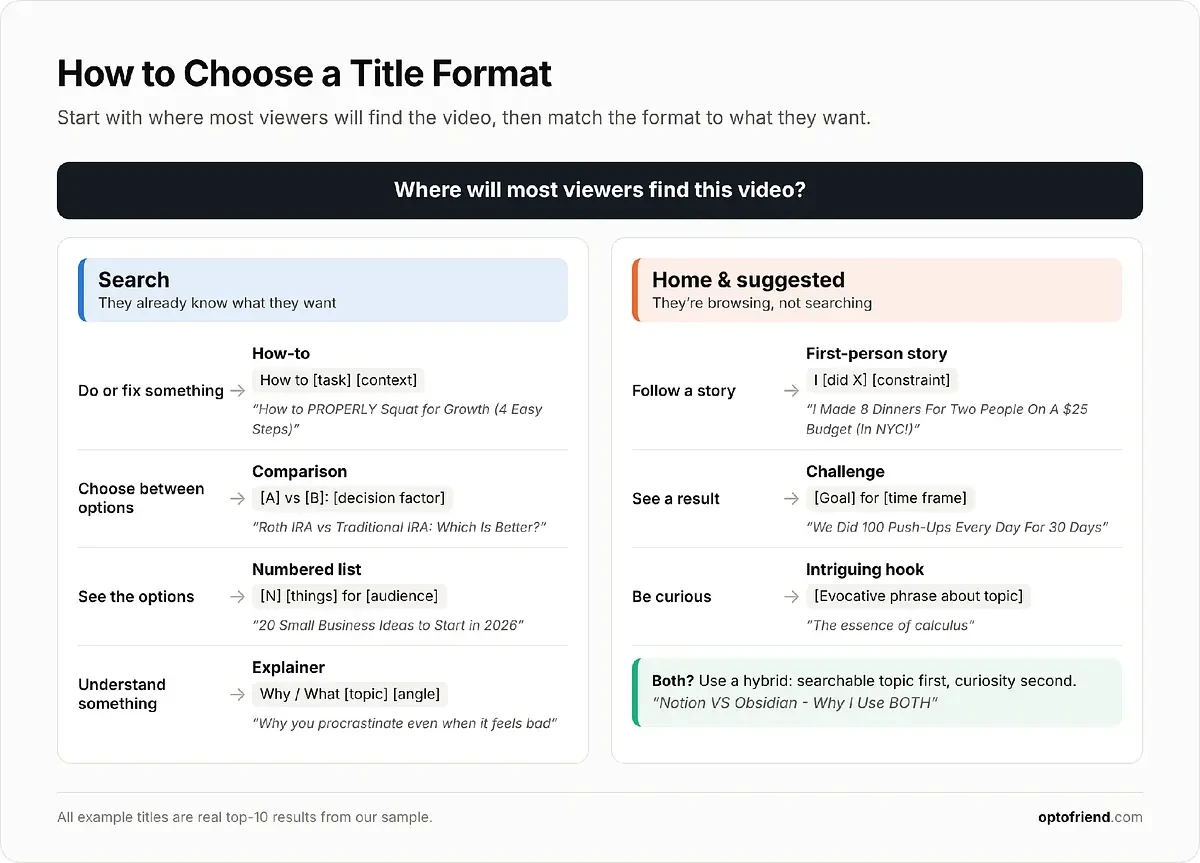
Video goal |
Starting structure |
Alternative |
What to monitor |
|---|---|---|---|
Teach a task |
How to [task] [context] |
[Topic] for Beginners: [payoff] |
YouTube search traffic and search terms, audience retention |
Help viewers choose |
[A] vs [B]: [deciding factor] |
Is [A] Worth It? [verdict] |
Click-through rate from search, average view duration |
Recommend options |
[N] Best [things] for [audience] |
I Tested [N] [things]. [Result] |
Retention through the list, search vs. browse traffic |
Explain a concept |
Why [thing] [happens] |
[Concept] Explained in [time] |
Share of traffic from search vs. suggested videos |
Document an experience |
I [did X] for [time frame] |
[Result] After [time frame] |
Impressions and CTR from Home and suggested videos, watch time |
Share results |
[Result] in [time frame]: [how] |
[Topic] Case Study: [result] |
Watch time, comments asking for proof |
How to Test and Improve a YouTube Title
A title is a hypothesis until your analytics confirm it. Start by checking where views come from in YouTube Analytics: if most traffic comes from YouTube search, a clearer searchable title may help, and if it comes from Home and suggested videos, the curiosity side of the title matters more. Track impressions, click-through rate, average view duration, and watch time, and check the YouTube search terms that bring viewers to the video.
Use YouTube’s Built-In A/B Test
YouTube’s A/B test for titles and thumbnails lets you compare options directly. Here’s how it works, according to YouTube’s documentation:
You can test up to 3 titles, 3 thumbnails, or 3 title-and-thumbnail combinations, using one of three modes: title only, thumbnail only, or both.
The option with the highest watch time is shown to all viewers. If there’s no clear winner, the first option you uploaded stays.
The feature is available only on a computer in YouTube Studio, and you need to have advanced features enabled.
You can’t test Shorts, scheduled live streams, or Premieres (until they end and become regular videos), or videos that are made for kids, set for mature audiences, or private.
Tests should finish within two weeks. Changing the title or thumbnail during a test stops it, and you’ll have to restart.
Results come back as Winner, Performed Same, or Inconclusive.
To learn something from each test, test titles only so the thumbnail doesn’t muddy the result, make the options genuinely different angles, and keep a simple log of the date, the variants, and the outcome.
Need options worth testing? The next section shows how to generate them from your draft title or video.
Common YouTube Title Mistakes
Overpromising. Titles like “RESULTS GUARANTEED” or unverifiable income figures can win a click, but YouTube’s A/B test rewards watch time, and viewers who feel misled leave.
Generic titles. A title that only names the topic, such as a bare “my everyday makeup,” gives viewers no reason to choose it over the other nine results.
Crowding the start. Channel names, series names, and episode numbers belong at the end. The top results in our sample consistently put branding last (“| Allrecipes,” “| TED”).
Stuffing keywords. Repeating variations of the keyword, often separated by pipes, makes a title read like a tag list. Tags are the place for variations.
Copying top titles word for word. Several results in our sample have nearly identical titles, like “Minecraft: 3 Easy Starter Houses!” and “Minecraft: 3 SIMPLE Starter Houses!” Borrow the format, not the wording.
Outdated or unnecessary dates. A year helps when the answer changes every year. On evergreen content, it ages the video. One fitness result still carries a “[2021 Update]” label.
Treating Shorts, live streams, and long-form videos the same. Our data covers regular search results only, and YouTube’s A/B test isn’t available for Shorts or scheduled live streams. Judge each format by its own analytics.
Unsupported claims about money, health, or science. In high-stakes niches, a title that promises more than the video delivers costs trust as well as views.
How We Analyzed YouTube Titles
Keywords: 10 niches with five keywords each, 50 keywords in total. Each keyword was labeled with a search intent: tutorial, beginner, problem solving, list, review, comparison, explainer, challenge, case study, strategy, recipe, or transformation.
Results: the top 10 video results for each keyword. Three keywords returned fewer than 10 videos, giving 492 results. Six videos appeared under two keywords, leaving 486 unique videos with 982.5 million combined views.
Fields collected: niche, keyword, search intent, video URL, title, view count, description, and tags. We didn’t collect position within the top 10, publish date, duration, channel size, or thumbnails.
Title formats: each title was assigned to one of 11 formats using rule-based pattern matching (for example, “vs” for comparison or “I tried” for first-person story). Rules were applied in a fixed order and spot-checked by hand, so the classification is approximate.
Title features: length in characters, whether the title contains the exact keyword or all its words, whether a keyword word appears in the first three words, numbers, years, punctuation, brackets and separators, ALL CAPS words (excluding acronyms like PC or SEO), emoji, pronouns, and common modifiers.
Views: each video’s views were converted to a rank from 0 to 100 within its keyword, so videos are only compared with others in the same search. Differences between titles with and without a trait were tested with a permutation test (4,000 shuffles, p < 0.05). Niche-level figures count each unique video once.
Limitations: search results vary by location, language, history, and time, and this is a single snapshot. View counts reflect video age and channel size, not just the title, and a high ranking doesn’t prove the title caused it. About 50 videos per niche means niche patterns are directional. A few non-English titles are included, and Shorts weren’t part of the sample.
To replicate or extend this analysis, the YouTube Data API’s search.list and videos endpoints return the same fields.
Frequently Asked Questions
What is the best YouTube title length?
YouTube doesn’t give a number. It advises keeping titles short and putting the most important words first. In our data, the median top-ranking title is 53 characters, and half fall between 43 and 65. Titles under 40 characters had the highest average view rank, and titles of 80+ characters had the lowest. Write the shortest title that still says what the video is and who it’s for.
Should I put keywords at the beginning of my YouTube title?
Put the most important words near the beginning, which is usually the topic. 60% of top results have a keyword word in the first three words. You don’t need the exact search phrase, though: only 10% of top titles use it.
Are questions better than statements in YouTube titles?
Not in general. Only 13% of top titles are questions, and they showed no reliable difference in views. Questions work best when they’re the exact question the viewer has, such as “Which Is Better?” in a comparison or “Is It Worth It?” in a review.
Do numbers, brackets, or emojis increase views?
Our data showed no reliable difference for any of them. Numbers appear in 53% of top titles, brackets in 21%, and emoji in only 6%. Use them when they carry information, like a list count, a duration, or a model number.
Do gaming, finance, and educational channels need different title styles?
Yes. Gaming titles lean on numbers (80%) and established formats like “100 days” challenges. Finance titles favor how-to and comparison formats with plain language and no emoji. Education titles are the shortest and least decorated, with no years or emoji at all.
Should I add the year to a YouTube title?
Only when the year changes the answer, as with product roundups or pricing. 40% of consumer tech titles include a year, while no education titles do. On evergreen content, a year makes the video look dated sooner.
Can changing the title improve views?
It can, because the title affects who clicks and whether they stay, but there’s no guarantee. The safest way to find out is YouTube’s A/B test, which picks a winner based on watch time.
Can I test different titles in YouTube Studio?
Yes. The A/B test lets you compare up to three titles, thumbnails, or combinations on eligible long-form videos, using YouTube Studio on a computer with advanced features enabled.
Are YouTube Shorts title best practices different?
Our analysis didn’t include Shorts, so we can’t say which formats work best there. Shorts titles have the same 100-character limit, but the A/B test isn’t available for them, so rely on your own analytics when comparing approaches.
How to Optimize Your Title With Optofriend
Everything above comes down to a repeatable process: understand the intent, pick a format, and draft several distinct angles. Optofriend’s title optimization tool speeds up the drafting part. You give it your video and a working title or idea, and it returns ranked title variants built for curiosity, relevance, and search discoverability. You then pick the best one using the rules from this guide.
Step 1: Add Your Video Context
Open the YouTube title optimization tool and choose how to describe your video. There are three options:
YouTube Video URL. Best for videos that are already uploaded. The tool pulls the video’s metadata and transcript for context.
Script. Best before you publish. The script is summarized before titles are generated, and long scripts are split into 3,000-character chunks, so you can paste the whole thing.
Description or Summary. Best when you already know the topic and key points and just want to write them down in a few sentences.
The more context you give, the more closely the suggestions can reflect what’s actually in the video, which matters because an accurate title is the first rule of this guide.
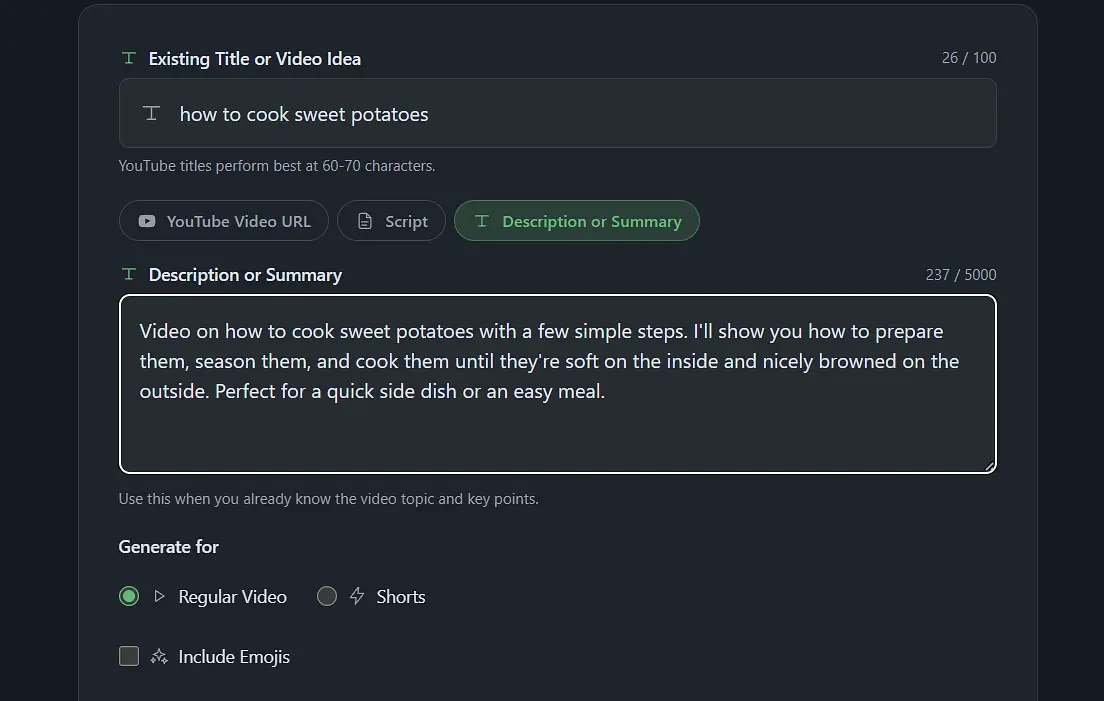
Step 2: Enter Your Current Title or Video Idea
Paste your draft title into the Existing Title or Video Idea field. If you don’t have one yet, describe the idea in a few words, such as “30-day push-up challenge results” or “Roth vs traditional IRA for beginners.” The tool uses it as the starting point and looks for ways to improve it.
Step 3: Choose the Video Format and Emoji Setting
Under Generate for, choose Regular Video or Shorts so the suggestions fit where the video will appear. Then decide whether to turn on Include Emojis. Our data suggests leaving it off in most niches: only 6% of top-ranking titles use emoji, and none of the education, personal finance, marketing, or fitness titles in our sample do. Business (14%), consumer tech (12%), and gaming (10%) use them most, and even there they’re the exception.
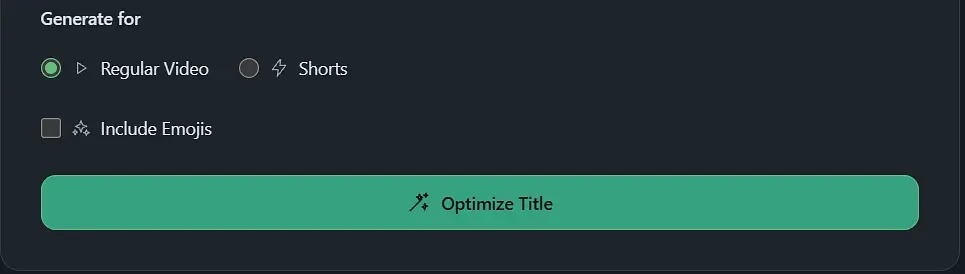
Step 4: Click Optimize Title and Review the Variants
Click Optimize Title. The tool analyzes your input for click-through potential, SEO, and alignment with search intent, then returns a ranked list of title variants. Read through all of them, not just the top one, because different variants often take different angles: one may be more searchable, another more curiosity-driven.
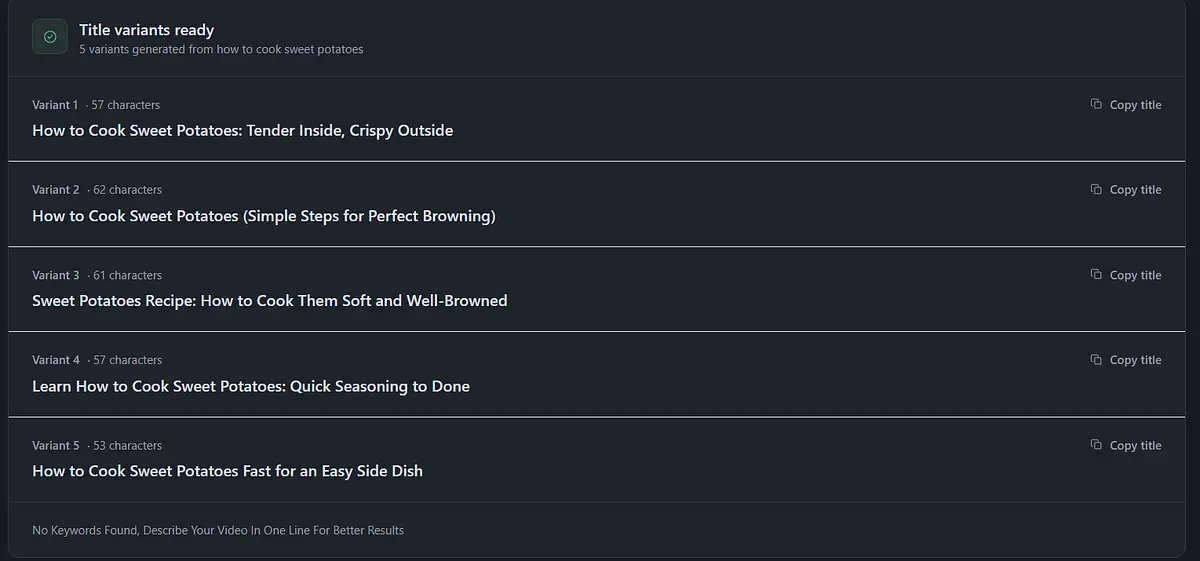
Step 5: Pick, Refine, and Test
Treat the variants as strong drafts, not final answers. Before you publish, run your favorites through this checklist:
Does it match the search intent? A comparison video should read like a comparison, a tutorial like a how-to. Check the niche sections for the format your viewers expect.
Is the topic near the start? The most important words should come first, with branding at the end.
Is it concise? Most top-ranking titles in our sample are between 43 and 65 characters. Cut any word that doesn’t add information.
Is it accurate? The video has to deliver what the title promises, or viewers will leave.
Does it complement the thumbnail? The title should add information the thumbnail doesn’t show.
Then shortlist two or three variants that take genuinely different angles and run them through YouTube’s A/B test to see which one earns the most watch time. Once the title is set, generate a matching tag list with Optofriend’s tag recommendations tool.
Conclusion
There’s no single best YouTube title, but there is a best title for your viewer and your niche. Match the format to the search intent, put the topic first, keep the title concise, and make a promise the video keeps. Use the niche patterns in this guide as a starting point, borrow formats rather than wording, and let your analytics and A/B tests decide what stays.
To put this into practice, use Optofriend’s title optimization tool to generate ranked title variants from your video, then refine and test them as described in How to Optimize Your Title With Optofriend. Once the title is set, Optofriend’s tag recommendations tool builds a matching tag list, and the tag extractor shows what top-ranking competitors use.